


How do Acramit PVC products react to fire?
Polmar Profil Sp. z o.o. has been manufacturing wall protection systems for many years, including wall panels, corner guards, bumpers, and handrails under the Acramit brand. For this purpose, it uses high-quality PVC (polyvinyl chloride), a plastic material that is naturally fire-resistant—the only one of its kind among general-purpose plastics.
What gives PVC its fire resistance?
When PVC products burn, hydrogen chloride released during thermal cracking slows down the combustion process and prevents the spread of fire by isolating the material surface from oxygen in the air.
This gas has a characteristic, very unpleasant odor that can be detected at concentrations far lower than those harmful to human health. This property allows for early fire detection. At the same time, hydrogen chloride is significantly less dangerous than carbon monoxide, which has a narcotic effect, is odorless, and can quickly lead to paralysis and death.
Another advantage of PVC is that it releases less heat during combustion compared to other plastics, which limits fire growth and spread. Additionally, PVC does not produce flaming droplets or debris.
The combustion of PVC leads to the formation of a carbonaceous structure known as “intumescence,” a swelling phenomenon that creates a thermal barrier protecting underlying elements.
Where can PVC be used?
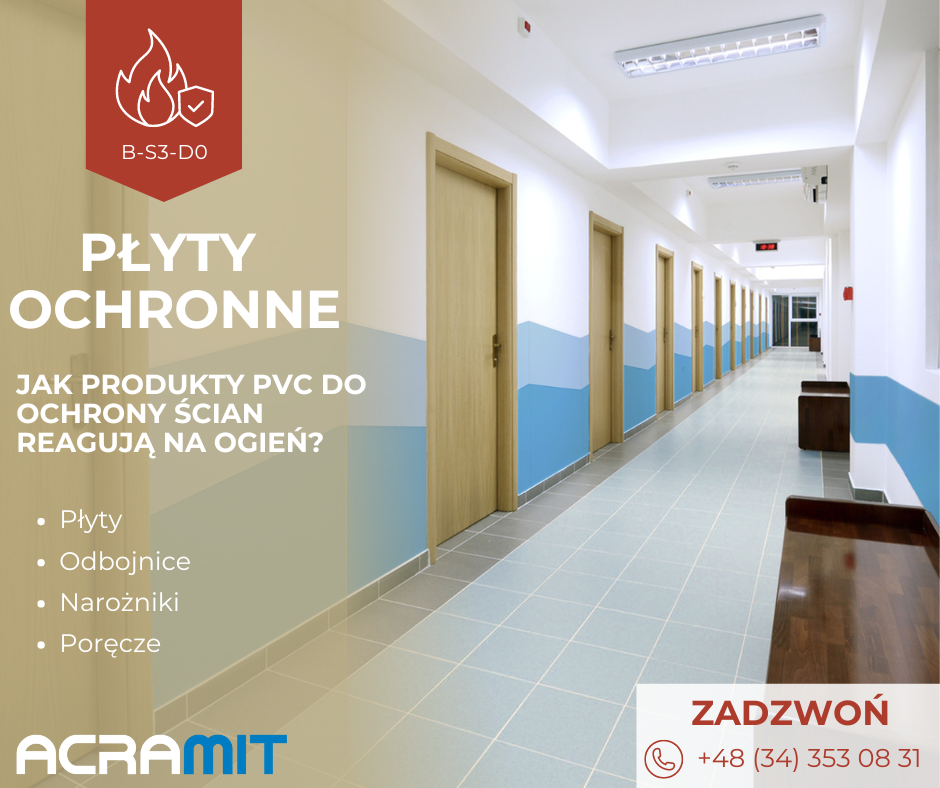
Thanks to its high fire resistance, PVC is widely used in external building materials such as window profiles and façade cladding, as well as in interior finishing materials like wall and floor coverings. It is also used in industrial facilities, including tanks, pipelines, strip curtains, information boards, corrugated sheets, and cable covers.
Polmar Profil Sp. z o.o. uses PVC to manufacture wall panels, bumpers, handrails, and combined handrail-bumper systems.
Are other plastics better than PVC?
Fire resistance can also be imparted to polyolefin plastics such as PE (polyethylene) and PP (polypropylene). You may encounter so-called non-PVC materials.
In this group, fire resistance is achieved through cross-linking or by adding large amounts of flame retardants. Unfortunately, such materials are more difficult to process (higher technological costs and greater carbon footprint) and are less recyclable.
How is fire classification of plastics defined?
With regard to the fire classification of Acramit products, the Scientific and Research Centre for Fire Protection of the State Research Institute has confirmed their reaction-to-fire classification at the level of B–s3, d0. This means they are safe for use in indoor environments.
 Polish
 German